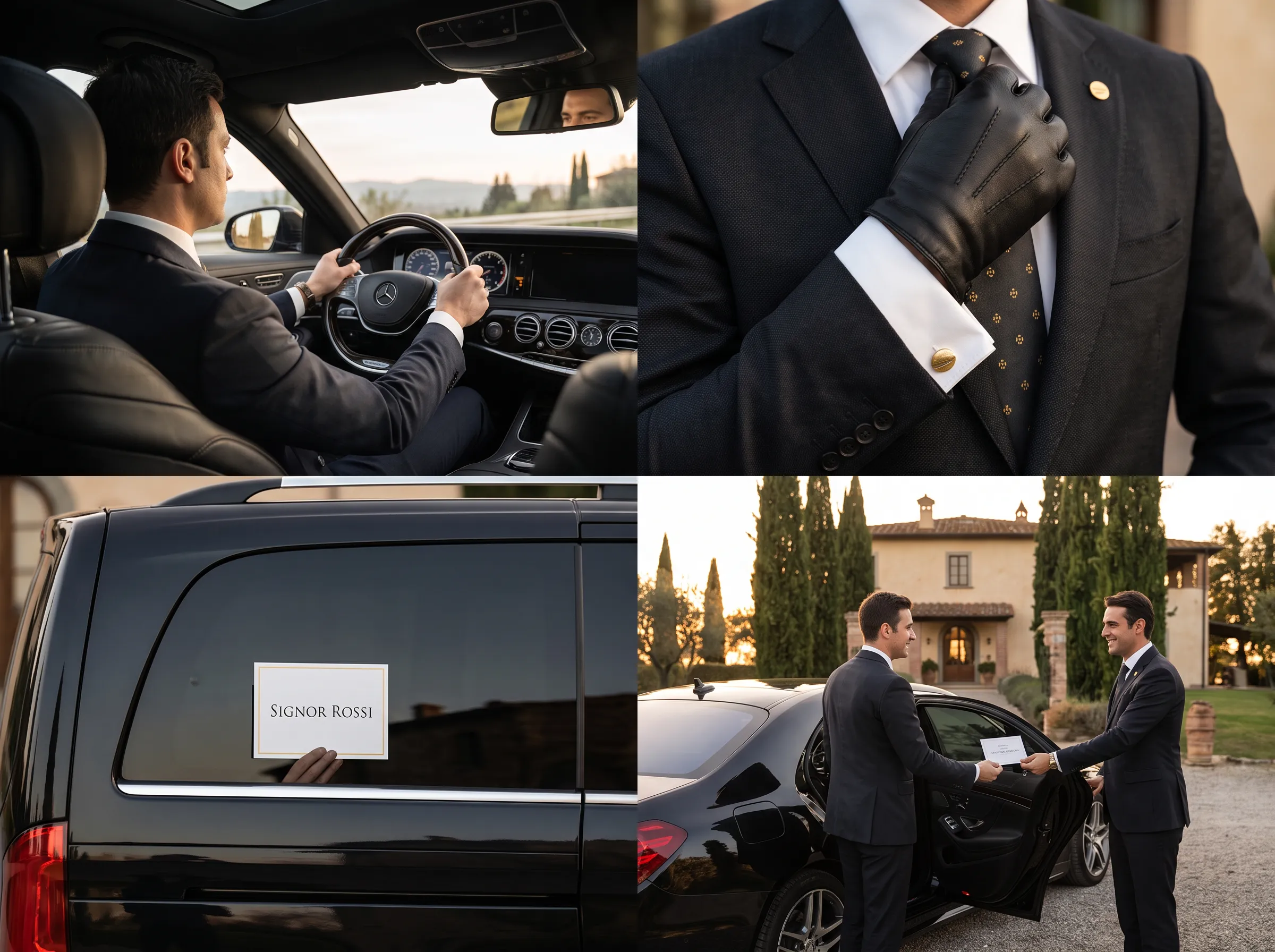
Most international couples picture Tuscany as hills, cypresses and a villa at the end of a gravel drive. The Versilia is none of that, and a countryside transport plan does not fit it. It is a narrow strip of coastline in north-western Tuscany, built up almost continuously, where venues and hotels sit within a few kilometres of each other and one line of road carries all of them. Forte dei Marmi wedding transportation is therefore a different exercise from a Chianti wedding: distances are short, times are unpredictable, and the busiest weeks of the Italian year fall inside wedding season. What follows is what a planner working from abroad cannot read off a map.
Where the Versilia is, and why couples choose it
The Versilia runs along the Tyrrhenian coast between Viareggio and the Ligurian border, with the Apuan Alps rising a few kilometres inland. Forte dei Marmi is its best-known town internationally; Pietrasanta, just inland, is a small historic centre known for sculpture; Camaiore sits in the hills behind, below the marble quarries.
Couples choose it over the countryside for reasons that also shape the logistics: a beach, so ceremonies and dinners can happen on the water; many hotels close together rather than one estate; Pisa airport nearby; Florence reachable for a day, as a planned trip rather than a short hop. rposr
That mix shapes the week around the wedding, beach days alternating with excursions. Keep excursion vehicles separate from wedding-day vehicles, so a group running late back from Florence never touches a ceremony transfer, and place long outings away from peak coastal hours. Routes into the quarries are not ordinary roads, and access for a venue or a photo session up there is confirmed case by case.
In Italy, private transport with a driver is supplied by an NCC — noleggio con conducente, a licensed private-hire operator. We call it a chauffeur service throughout.
Why a countryside transport plan does not work here
Our guide to wedding transportation in Tuscany is built around inland venues: remote estates, unpaved access roads, long legs between hotels and ceremony. Its logic on flows, sizing and late-night returns still applies; the geography behind it does not.
Three things invert on the coast. There are few usable road axes, so when one saturates there is no real alternative. Movements from inland to the sea cut across those axes rather than around them, so four kilometres can hold more friction than twenty in the hills. And journey times are unstable rather than long: the same leg can take fifteen minutes on a Tuesday in May and twice that on an August Saturday evening.
| Countryside wedding | Versilia wedding | |
| Typical distances | 20–40 km between hotels and venue | often under 10 km |
| What adds time | road surface, narrow lanes, climbs | congestion, crossings, parking |
| Predictability | stable from May to October | low in peak season: a leg can double |
| The access question | can the vehicle reach it? | where can the vehicle stop? |
| Shuttle strategy | one large synchronised move | short repeated loops, mid-size vehicles |
| A guest who misses a shuttle | needs a dedicated car | catches the next loop |
The access row is the one planners underestimate. Inland, the question is whether a vehicle can reach the venue; on the coast it almost always can, and the question is where it can stop. Near the sea in high season kerb space is the scarce resource, and the spot where a minibus can pull in to set down twenty guests may not be free. Agree set-down points in writing with each hotel and with the venue, and tell guests in advance when the last hundred metres are on foot — it matters for heels and for limited mobility. Seasonal traffic restrictions in the coastal centres change year to year.
August on the Italian coast is a different operating environment
This is the warning no map gives you. The Italian coast in August is not simply busier: it runs at capacity, because the country itself is on holiday there. Travel times must be inflated against any estimate, Saturdays carry the heaviest road pressure because accommodation turns over week to week, and evenings along the seafront are the least predictable hours.
It also changes supply. Operators working the Versilia have much of their fleet committed to recurring seasonal work in those weeks, and qualified drivers, not vehicles, are the binding constraint on a peak Saturday.
May, early June and September behave differently: times closer to estimate, easier set-down, room to re-time a departure during the day. The trade-off is weather exposure for a beach ceremony, and a wet-weather plan with its own transport timings.
Planning from abroad, months ahead
Coastal suppliers fill their season long before it starts, so the sequence that works is: confirm date and venue, reserve the operator on a provisional programme, refine the detail later. A quote can be revised at any point; a committed August Saturday cannot.
- Reserve on the programme, not on a guest count. Numbers move; the shape of the days does not.
- Fix in writing the threshold at which a vehicle is added, and the last date to change it.
- Allow for time zones: every clarification costs a working day, so set internal deadlines a week earlier than feels necessary.
- Ask whether the operator has worked the coast in peak weeks, and what their set-down arrangement is at your venue.
Planners who work the region keep one operator across seasons rather than re-tender each wedding; we have written separately about building a working partnership with an Italian chauffeur operator.
Pisa changes the maths
Pisa airport sits close to the Versilia — a transfer measured in tens of minutes in normal conditions, not the hours a Val d’Orcia wedding requires.
Three things follow. An awkward flight stays workable: a late-evening or early-morning arrival needs no staging hotel built around it. Flights can be combined on tighter margins, since waiting forty minutes to merge two arrivals is reasonable when the onward leg is short. And the airport stays usable all week, so guests arriving either side of the wedding do not force a rebuild of the plan. Group handling on this route has its own rules, set out in our piece on Pisa airport transfers to Forte dei Marmi; for collecting flight data and managing guests arriving from several countries, see handling international arrivals for an Italian wedding.
Guest shuttles when everyone is in a different hotel
Inland, guests spread across ten properties is the worst case: each hotel is a detour and the pick-up run costs an hour before anyone moves. On the coast the same fact works in your favour. Ten hotels between Marina di Pietrasanta and Forte dei Marmi sit within a few kilometres, and one vehicle touches all of them in the time an inland shuttle needs to reach one.
So the model changes. Instead of a single synchronised transfer, run a loop service: two or three mid-size vehicles repeating a short circuit across closely spaced windows. A twenty-minute loop inside a one-hour window is worth two and a half rotations per vehicle, so the same guest list moves with fewer vehicles at once. A guest who comes down late waits for the next pass rather than needing a dedicated car, so you can size closer to the real number than you would inland. It also makes a second wave realistic: an afternoon ceremony, a return to the hotels to change or settle children, then the reception.
The condition is that the stop order is set in advance, with a named list per hotel and someone counting heads.
Frequently asked questions
Where is Versilia, and how far is it from Pisa airport?
The Versilia is the coastal strip of north-western Tuscany, between Viareggio and the Ligurian border, with the Apuan Alps immediately behind it; Forte dei Marmi is its best-known town internationally. Pisa airport is the nearest major gateway, and the transfer is measured in tens of minutes rather than hours, which is unusual for Tuscany. In peak season add time to any estimate, particularly on weekend evenings, and pair a fixed-time transfer with flight monitoring.
Do we need shuttles if guests are staying in several small hotels?
Yes, but fewer vehicles than you would expect, running more often. When hotels sit within a few kilometres, a short repeated loop with a fixed order of stops moves far more people than one vehicle tied up in a single long transfer. The number depends on total guests, the real duration of the loop at that hour and how wide the window is — not on seat capacity.
Is August a difficult month for a wedding on the Tuscan coast?
It is workable but demanding. August is the peak of the Italian domestic holiday season on the coast, so roads, parking and supplier availability tighten at once, and Saturdays carry the heaviest traffic. Plan wider windows, inflate every journey estimate and book your operator far earlier than you would inland. September offers much of the same weather with materially easier logistics, which is why many planners steer couples there.
Can we combine beach days with a trip to Florence during the wedding week?
Yes, and it is one of the reasons couples choose this coast. Florence is a planned day trip rather than a casual outing, so give it its own vehicles and timings, separate from anything tied to the wedding day. Lucca is closer and works as a half-day. Schedule the return outside peak coastal hours and agree set-down points in advance, since city-centre access is restricted.
Where to start
Before asking for a quote, prepare two documents: the programme for the days of the event with real times, last departure included, and the list of hotels with guest numbers and an agreed pick-up and set-down point for each. On the coast, the second replaces the villa-access check you would do inland.
Tradycom is based at Cascina, minutes from Pisa airport, with a recent Mercedes fleet and multilingual drivers. If you are planning a wedding on this coast and want the timings and stopping points tested against peak-season conditions, write to info@tradycom.com with your dates and venues.