You are booking ground transport in a country you may never have worked in, for an airport you have never seen, with a company you cannot visit. The flights are confirmed, the venue is confirmed, and the one element still unresolved is how thirty people get from the terminal to the property before the welcome dinner.
A Pisa airport group transfer is usually simpler to run than the equivalent at a large hub, for reasons worth understanding before you compare quotes. But several assumptions that travel well elsewhere do not survive the trip to Tuscany: that the cheapest flight lands at the most convenient airport, that distance in kilometres predicts driving time, and that “airport shuttle” means here what it means in Chicago or Manchester. This guide covers what to decide before you request a quote, and what to check before you commit.
Which Italian airport actually works for a Tuscan programme
Most Tuscan programmes can be reached from four airports, and the flight price is the least reliable way to choose between them.
| Airport | Best for | What coordinators underestimate |
| Pisa (PSA) | Most of the Tuscan coast, Lucca, Versilia, and the western wedding and villa country | Small enough that a group clears the terminal quickly — a real operational advantage |
| Florence (FLR) | Florence city programmes only | A small airport with a limited route network and more weather-related disruption |
| Rome Fiumicino (FCO) | Long-haul arrivals with no European connection | The drive north into Tuscany is a journey in its own right, not an airport transfer |
| Milan Malpensa (MXP) | Long-haul connectivity, programmes that start in the north | Same trade-off as Rome, in the opposite direction |
Two points change decisions. Florence’s airport is genuinely small, so many long-haul passengers arrive elsewhere and connect or drive; planning a Florence programme around FLR without a fallback is a risk, not a plan. And a cheaper long-haul flight into Rome or Milan is paid for in full on the road — the ground cost, the hours, and the condition your delegates are in at the first session. If the programme starts in the north, the Malpensa route into Italian business events deserves its own planning conversation.
What a “chauffeur service” is in Italy, and what it is not
Ground transport in Italy comes either from taxis or from a private chauffeur service — in Italy an NCC, or noleggio con conducente, a licensed private-hire operator. It is a regulated category: vehicles are booked in advance, not hailed. Two translation traps are worth naming.
“Airport shuttle” in North America often means a shared, scheduled bus. In Italy, what you are buying from a chauffeur company is a private vehicle assigned to your group, on your schedule. Shared shuttles exist, but they are a different product with different reliability.
“Limo service” does not translate. Stretch limousines are essentially absent from Italian corporate travel; the equivalent here is a premium sedan or a lounge-configured minivan with a professional chauffeur. Asking for a limousine will either confuse the conversation or produce a wedding car.
Italian chauffeur companies are also often small, family-run and long-established rather than large branded fleets. That is normal, not a warning sign, but it changes how you vet them.
Arrivals at Pisa: what to expect on the ground
Pisa’s Galileo Galilei (IATA code PSA) is a compact airport: internal walking distances are short and there are no remote terminal transfers to build into your timings. For a group, that predictability matters more than any amenity — the dominant variable is baggage delivery, not the building.
Passport control depends on the route, not the destination. Passengers from the UK, the US or anywhere outside the Schengen Area clear immigration at their first point of entry into the zone. A group connecting through Frankfurt, Amsterdam or Paris therefore arrives in Pisa on a Schengen sector and steps straight into the baggage hall; a group on a direct non-Schengen service clears immigration at Pisa itself, and needs meaningfully more time. Coordinators who apply one buffer to a mixed group routinely get this wrong.
As a planning rule, allow roughly 40 to 60 minutes between landing and the vehicle actually pulling away for a group with checked baggage, and more where border control applies. Where a tight arrival window genuinely matters for a small delegation, it is worth looking at how Fast Track services fit into transfer planning — the time saved is only real if the vehicle is already in position.
Why Italian distances do not read in kilometres
A route that looks short on a map can be slow, and a longer motorway route is often faster. Two factors explain most of the gap: Tuscan secondary roads through hill country are winding and narrow, and most historic centres are restricted traffic zones, so the final few hundred metres may be on foot with luggage.
| From Pisa airport to | Order of magnitude | What to plan around |
| Pisa city centre | A few minutes | Restricted access in the historic centre; confirm the drop-off point |
| Lucca | About half an hour | Vehicles cannot drive freely inside the city walls |
| Versilia and Forte dei Marmi | Around an hour | Coastal traffic lengthens this considerably in high season |
| Florence | A little over an hour in normal conditions | The bottleneck is the last kilometre inside the city |
| Chianti | About an hour and a half | Narrow approach roads; confirm a large vehicle can reach the property |
| Siena | About two hours | If the whole programme sits south, reconsider the arrival airport |
Treat these as orders of magnitude for building a schedule, never as times to promise a client. And confirm with the property that the vehicle you booked can physically reach the entrance: villa and agriturismo access roads are a recurring problem for minibuses.
Sizing vehicles for a Pisa airport group transfer
Stated seat counts are a technical capacity, not a comfortable capacity with luggage. For an airport run, plan on one large suitcase plus one carry-on per passenger and check volume rather than seats.
| Passengers | Typical solution | Planning note |
| 1–3 | Executive sedan (Mercedes E-Class) | Three large cases will fill the boot |
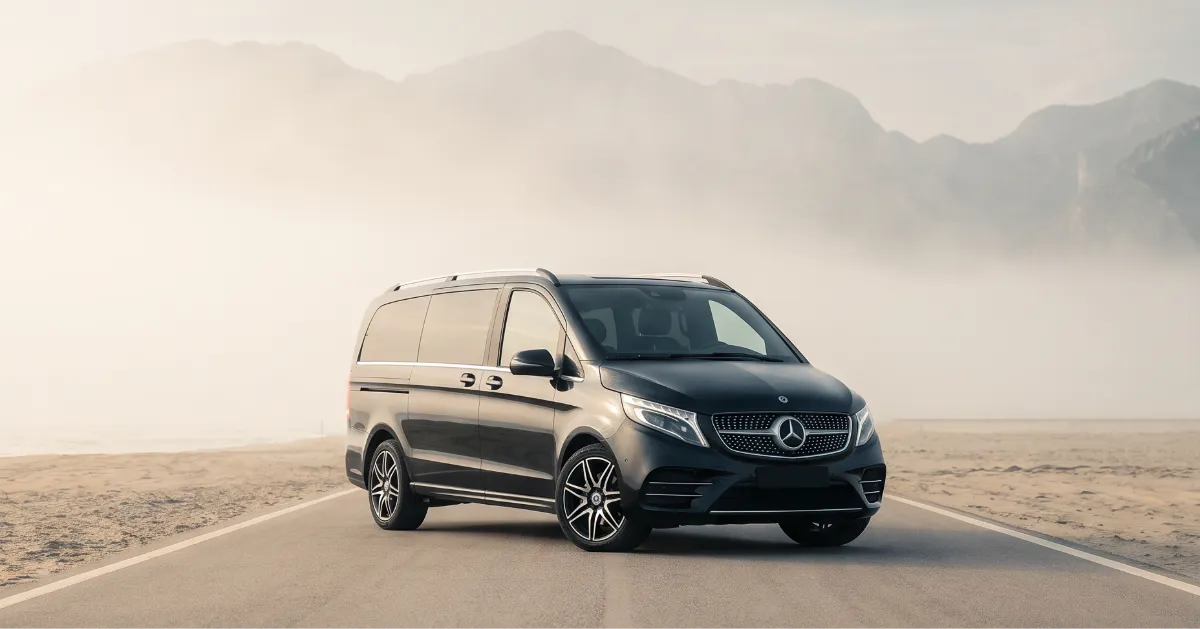
| 4–7 | Lounge minivan (Mercedes V-Class) | Face-to-face seating is useful for briefings but reduces luggage space |
| 8–16 | Van (Mercedes Vito, up to 8) or minibus (Mercedes Sprinter, up to 16) | With 16 passengers and full checked baggage, expect a second vehicle |
| 16–40 | Multiple minibuses, often with a sedan for speakers or executives | Size this on luggage volume, not headcount |
| 40+ | Coach, usually alongside executive vehicles for VIPs | Large coaches fall under a separate Italian licensing category and need earlier coordination |
Splitting a group across two vehicles often costs less in total time than one larger vehicle waiting for the last arrival, and it distributes risk. Detailed programme structure for recurring corporate arrivals is covered in the guide to corporate group arrivals at Pisa airport.
Staggered arrivals and delayed flights
International groups almost never arrive on one flight. There are three workable approaches: hold one vehicle until everyone is aboard, which works when the arrival window is compact but leaves early arrivals waiting; run separate departures per arrival block, which removes waiting at the cost of more vehicles; or rotate a single vehicle, which only works when the destination is close and the round trip is shorter than the gap between arrivals.
On delays, flight tracking is standard and should be assumed. The questions that actually separate operators are narrower. Ask when the included waiting allowance starts — scheduled landing time or actual landing time, because on a delayed flight that is the whole difference. Ask what happens to the next pickup on the same vehicle: an operator with spare capacity and a base close to the airport can reassign it, while an operator without one passes your delay down the day. Tradycom is based in Cascina, minutes from the airport, which is why repositioning a vehicle there is measured in minutes rather than in a long empty run.
Overnight and very early arrivals deserve specific attention, particularly for groups crossing several time zones, and are dealt with in the guide to late-night transfers for international arrivals.
Booking a company you have never met
This is the part that keeps coordinators awake, and it is manageable with a short set of checks.
- Ask for a written confirmation that names things: vehicle type, passenger count, pickup point, driver contact and a 24-hour operations number. A confirmation that restates your request without adding operational detail is not a confirmation.
- Ask how they handle the arrival if nobody answers the phone. The answer reveals whether there is a dispatcher behind the driver.
- Ask about licensing and insurance directly. Private chauffeur work is licensed in Italy and a legitimate operator answers plainly; reluctance here is the strongest signal you will get.
- Ask who your single point of contact is on the day, by name, and whether they are reachable outside office hours.
- Prefer a fixed price for the route over a meter-based estimate, so the figure you approve is the figure you reconcile.
On money: quotes are in euros, and payment is normally by bank transfer or card, often with a deposit or full prepayment for group work. Costs are built from vehicle time, distance and time-of-day windows rather than a per-kilometre rate, which is why night work is priced differently. If you need documentation for expense reporting, ask at booking for a proper invoice with your company’s billing details and VAT number — far easier to arrange before the service than after.
Drivers, language and meet and greet
Ask whether an English-speaking chauffeur is confirmed for your date, not whether the company has English-speaking chauffeurs. Those are different commitments, and for a group arriving jet-lagged at midnight the difference is real.
Meet and greet is not always necessary. For a single-flight group with an experienced leader, the driver’s name, vehicle details and pickup point sent in advance are enough. It becomes necessary with staggered arrivals, passengers who do not know each other, or guests arriving in Italy for the first time. When you use it, confirm that the person in arrivals has a sign showing the event or company name rather than one surname, a passenger list broken down by flight, and a mobile number already given to the group.
Before the group lands: a short checklist
- Send the driver’s name, vehicle description and meeting point in one plain-language message, the day before.
- Include a WhatsApp-capable number. WhatsApp is the default business messaging channel in Italy and usually gets a faster response than a call.
- Tell passengers what to do if they do not see the driver: call the driver first, then the operator’s 24-hour line, stay at the agreed meeting point, and do not split up to search.
- Give the operator one on-site contact who will actually answer on arrival day.
- Confirm return timings alongside arrivals, even provisionally, so vehicle availability is planned rather than renegotiated mid-programme.
Frequently asked questions
Should our group fly into Pisa or Florence for a Tuscan event?
For most groups, Pisa. It has a broader route network, and its compact layout means a group clears the terminal predictably — which matters more than a few kilometres of driving. Florence is closer to the city but is a small airport with fewer connections and greater exposure to weather disruption. If the whole programme sits in or around Florence and suitable flights exist, FLR can work, but build a fallback: a diversion with thirty people aboard is a problem you want solved in advance.
How long does it take to drive from Pisa airport to Florence?
A little over an hour in normal conditions, with the caveat that the final stretch inside Florence can add meaningfully to that. Italian historic centres are restricted traffic zones, so the drop-off point is often not the hotel door. Build the schedule on orders of magnitude rather than precise times, and confirm the drop-off location with the hotel in advance — particularly for a minibus, which has fewer options than a sedan.
Do we need to prepay a group transfer in Italy?
Usually some form of advance payment is expected for group work — a deposit or full prepayment, by bank transfer or card, in euros. That is standard practice, not a warning sign. What matters is what you get in exchange: a written confirmation naming the vehicles, the pickup arrangements and a 24-hour contact. If you need a VAT invoice for expense reporting, request it at booking with your company’s billing details rather than afterwards.
What happens if our flight is delayed?
A professional operator tracks the flight number and adjusts the pickup without you intervening. Two things are worth confirming in writing: when the included waiting time starts — scheduled or actual landing — and what happens to the next booking on that same vehicle. An operator with spare capacity nearby can reassign it; one without will pass the delay through to the rest of your day. This is why proximity to the airport and fleet depth matter more than a quote suggests.
Will our chauffeur speak English?
At professional operators, generally yes — but confirm it for your specific booking and date rather than assuming a company-wide standard. If your group includes guests who speak neither English nor Italian, say so at the quoting stage. It is also worth agreeing how the chauffeur will contact the group on arrival: a short message and a named point of contact prevent most of the confusion that happens in an unfamiliar terminal.
Where to start
If you are planning group arrivals into Tuscany, three decisions do most of the work. Choose the airport on the whole programme, not the flight fare. Size vehicles on luggage volume, not headcount. And put the arrival-day procedure in writing — meeting point, contact numbers, and what happens to a passenger who does not appear.
For the rest, the operator matters: spare capacity, genuine out-of-hours contact, and proximity to the airport. Tradycom has been in chauffeured transport since 1970 and is based in Cascina, minutes from Pisa airport, with a Mercedes-Benz fleet from executive sedans to sixteen-seat minibuses and multilingual chauffeurs.
If it would help to have your arrival plan reviewed before you commit to it, send your dates, flight numbers and final destination to info@tradycom.com.