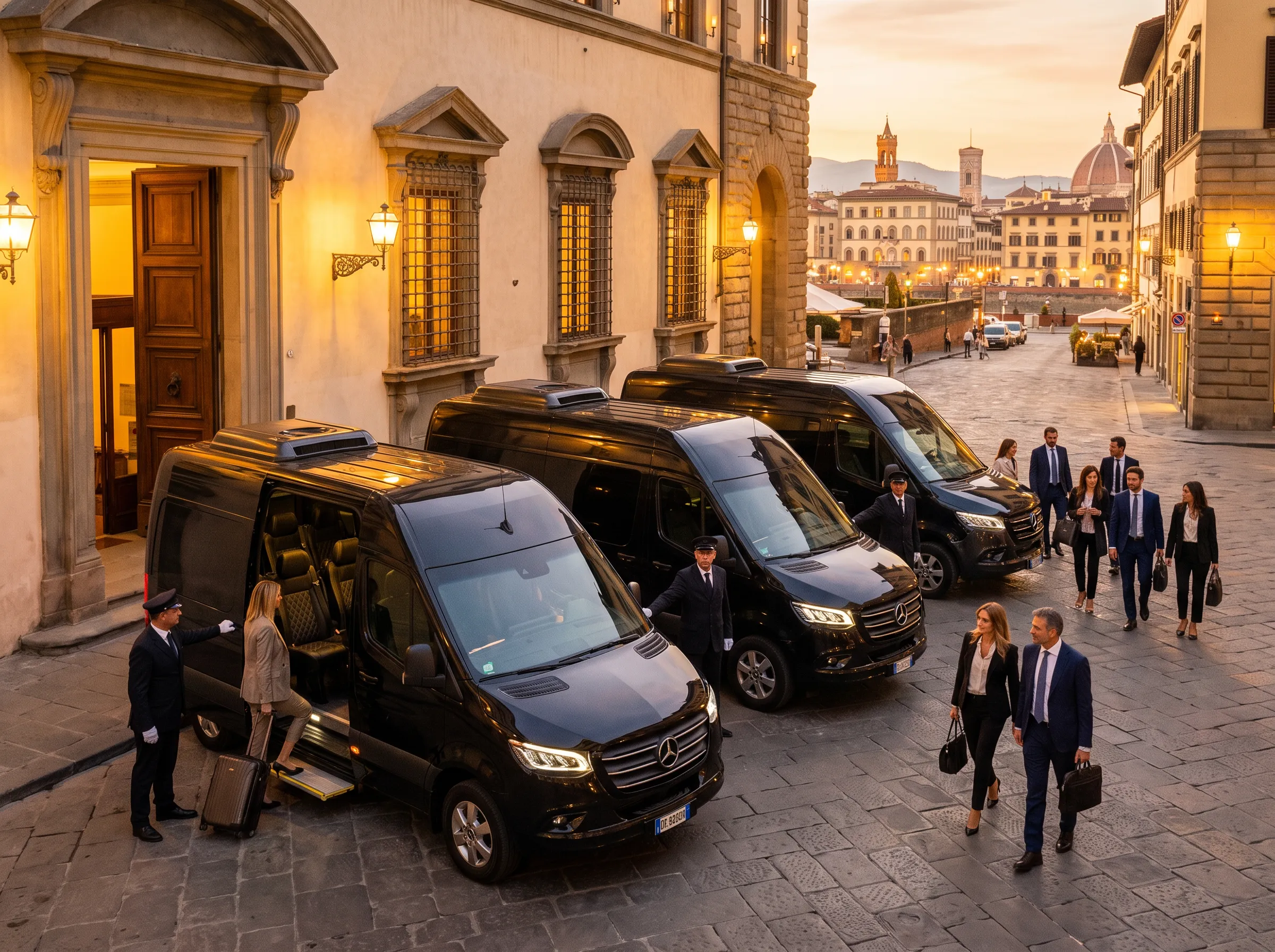
Your company sends people to Tuscany roughly once a month: an engineering team to a supplier near Pisa, two directors to a plant in the Arno valley, an audit group that stays three days. Each trip is small, three to eight people, and each is booked as if it were the first.
That is the real cost of a Pisa airport corporate transfer, and it appears on no invoice: the forty minutes someone spends re-explaining the same drop-off point, the expense line nobody can match to a cost centre. The operational side of a group arrival is covered in the Pisa airport group transfers planning guide. This article is the layer above it: how an overseas company turns an improvised booking into a standing arrangement.
Recurring travel is a process problem, not a logistics problem
An event is a peak: forty delegates land inside a three-hour window, once, and the plan exists only for that day. Recurring corporate travel is the opposite shape — small numbers, high frequency, the same delegation to the same plant ten times a year.
Nothing about any single trip is difficult. What is difficult is that none of the work carries over. The goal is not a better plan but one that does not have to be rebuilt, and everything below is written to that test: can it be decided once and then referenced?
Fitting a local supplier into an existing travel policy
Most travel policies were written around airlines, hotels and a global ground-transport provider, and a small Italian chauffeur company does not slot into that neatly. The usual reaction — route it through the global provider — removes the reason to use a local operator at all: global networks subcontract the final leg, so you pay an intermediary for a locally sourced vehicle, with one more layer between you and whoever actually arrives.
The workable approach is to approve the local operator for a defined scope: arrivals and departures at Pisa, plus ground movement within Tuscany, for groups of two or more. Three things make that stand up to procurement.
- A named scope, so it is clear what the supplier covers and what stays in the corporate channel.
- Pre-agreed pricing on the routes you actually use. Italian chauffeur work is quoted as a fixed price per route, built from vehicle time, distance and time-of-day window rather than a meter, which makes a standing rate card straightforward to agree.
- Documented licensing and insurance. Private chauffeur work in Italy is a licensed category — an NCC, or noleggio con conducente — and a legitimate operator provides these without hesitation.
Central booking or traveller self-booking?
Self-booking tools have pushed ground transport towards the traveller. For group travel into Italy, central booking wins, and not for policy reasons: a group transfer depends on information no individual traveller holds — who else is on the flight, how much luggage the group has between them, which plant gate to use, whether the return is confirmed. When three colleagues each book a car for the same flight, you pay for three vehicles and still have a coordination problem. Self-booking is fine for a lone traveller; for anything moving as a group, one requester with a named deputy is cheaper.
Set up once, send every time
The practical form of all this is a division: what the supplier stores permanently, and what you send each trip. Getting that boundary right removes the email exchanges.
| Agreed once, at account opening | Sent with every booking |
| Billing entity, VAT number, invoicing address, payment terms | Passenger names and group lead |
| Standing rate card for regular routes | Full flight numbers, in and out |
| Regular destinations: plant gate, where vehicles stop, badge requirements | Destination, if not a regular one |
| Cost centres and the reference to print on invoices | Luggage, including oversized items |
| On-board preferences; whether the group works in silence | On-site contact for the day |
| Named chauffeurs familiar with the group; confidentiality protocols where required | Return timing, even provisional, and anything unusual |
The left column is the part most companies never set up, and it is where the time goes. Two entries deserve a note. Flight numbers, not times: without the flight code there is no tracking, and tracking is what makes a delay harmless — what else to agree in advance is in the guide to flight delays and transfer planning. And named chauffeurs: a driver who has carried the group before knows which gate to use and how they prefer to travel. For board-level passengers, reception and discretion protocols belong in that column too, as covered in airport security protocols for VIP transfers.
Account structure, invoicing and cross-border reconciliation
For a company booking from abroad, administration causes more friction than transport. Consolidated monthly invoicing — one document covering every service that month instead of an invoice per trip — cuts data entry and makes the spend legible. Your reference on every line, cost centre or project code, means reconciliation does not depend on someone remembering which Thursday that car was. And the invoice must be issued to your company with full billing details and VAT number: far easier to arrange at booking than to correct afterwards. If your entity sits outside Italy, confirm the treatment at account opening rather than when the first invoice is queried.
Duty of care and knowing where your travellers are
The obligation does not pause between the terminal and the hotel, and that leg is usually the least documented part of a trip. What makes it visible is unglamorous: a written confirmation naming the vehicle, the chauffeur and a contact number; an operations line answered outside office hours by someone who knows your booking; one named contact on the day; and a rule given to travellers for when the chauffeur is not where they expect — call the chauffeur, then the operator, stay at the agreed meeting point.
Ask one more question at account opening: what happens to the next pickup on the same vehicle when a flight is delayed. An operator with spare capacity and a base near the airport reassigns it; Tradycom is based in Cascina, minutes from Pisa airport, which is why repositioning there is measured in minutes rather than a long empty run.
Why your group will not take the train
Visitors who know Italy by its cities sometimes propose the train. It works well between Florence, Pisa and Rome, and badly for corporate travel, for one structural reason: industrial sites are not next to stations.
A plant in the Valdera, a facility in the Lucca plain, a site behind the Versilia coast — each is a taxi ride from the nearest station, at a time of day when there may be no taxi. Add checked luggage, equipment cases and a group that must arrive together for a scheduled meeting, and the train is no longer cheaper. Drive times are modest — Pisa to Florence a little over an hour in normal conditions, the Versilia coast around an hour — but unforgiving in high season and on the last kilometres, where historic centres are restricted traffic zones and hillside roads narrow.
A language point belongs here too. Ask whether an English-speaking chauffeur is confirmed for your date, not whether the company has English-speaking chauffeurs: those are different commitments. Agree the messaging channel as well — WhatsApp is the default for business contact in Italy. When a programme grows from a delegation into a company meeting, the planning changes shape: that is the territory of Pisa airport transfers for MICE groups.
Frequently asked questions
Should we contract a chauffeur company or book trip by trip?
Frequency decides, not volume. Below two or three trips a year, booking each one separately is reasonable. Above that, a standing arrangement changes the work: billing details and preferences set once, known rates on regular routes, availability priority in busy periods, and a supplier who already knows your group. It need not be a formal contract — an agreed scope and rate card is usually enough, with each trip booked in a few lines against it.
How far ahead should we book a corporate transfer at Pisa airport?
Seven to ten days is comfortable for a small group to a known destination. Inside 48 hours, mid-size vehicle availability tightens, particularly during trade fairs and in summer along the coast. The more useful lead time is internal: if the request goes out when flights are booked rather than when meetings are confirmed, you gain days at no organisational cost.
Can we put an Italian chauffeur company on our corporate account?
Yes, and it is the normal arrangement for recurring work. What you are agreeing is an account rather than a series of bookings: billing entity and VAT details on file, agreed payment terms, consolidated monthly invoicing with your cost centre references, and a rate card for your routes. Set all of it at account opening: terms negotiated after a disputed invoice are harder to fix than terms agreed before the first trip.
What does a supplier need from an overseas client to run a programme well?
Less than most companies expect, but consistently: one requesting channel, a stable request format, administrative details fixed at the start, and access details for your regular destinations. In return, the supplier should hold the memory of your programme — preferences, gates, chauffeurs assigned to that group — rather than treating each request as new. That is the test of whether you have an account or just a phone number.
Where to start
If each trip currently costs you a round of emails, the fix is not a different supplier. It is the division in the table above: decide what is stored once, and reduce each booking to the few things that genuinely change. Then set the account up properly — billing entity, cost centre references, consolidated invoicing, rate card — before the first trip rather than after the first query.
Tradycom has worked in chauffeured transport since 1970 and is based in Cascina, minutes from Pisa airport, with a Mercedes-Benz fleet and multilingual chauffeurs. To set up a programme, send your regular destinations and approximate frequency to info@tradycom.com.