Three quotations from three Italian suppliers, three different totals, and no obvious way to tell what accounts for the gap. You cannot visit the garage or meet the drivers.
Appointing a chauffeur service for corporate events in Tuscany is an exercise in reading signals from a distance, and the vehicles are the least useful signal: every supplier offers recent cars with tinted glass. What separates the three documents is what they do not show — who coordinates, who actually drives, who answers the phone at 23:40 when a vehicle fails to arrive. This article is about the supplier rather than the plan: how the Italian category works, how to verify an operator remotely, and how to read the quotation that comes back.
What an NCC is, and why the category exists
Italian suppliers describe themselves as an NCC: noleggio con conducente, a licensed private-hire operator, a regulated category distinct from taxis and coach companies. Never read it as “rental with driver” — no self-drive hire is involved. From here on, chauffeur service.
The distinction is practical. Taxis are hailed or ranked and work municipally; a chauffeur service works on pre-arranged assignments, with a named vehicle, a named driver and an agreed schedule. Coach operators move volume on fixed routes, while chauffeur operators run vehicles up to roughly sixteen seats — which is why larger Tuscan programmes travel as convoys: smaller vehicles reach hill-town streets, unpaved estate approaches and restricted centres that coaches cannot.
A brief for one hundred delegates therefore comes back as eight or nine vehicles rather than two coaches, which is not upselling. The logistics behind such a plan are covered in our guide to corporate event transportation in Tuscany; here we ask who delivers it.
Verifying an operator you cannot visit
Four things separate an event-grade supplier from a competent transfer company, and none photographs well: held reserve capacity, active coordination, one named contact who knows the programme, and access management — permits, restricted-zone gates, authorised set-down points, a check of turning space at rural venues. Verifying them from abroad means asking questions whose answers cannot be improvised.
- Which vehicles in this plan are yours, and which come from colleagues? Subcontracting is normal — no Italian operator covers the country with its own fleet. What matters is the proportion, and whether it is declared. A weak answer offers “a network of selected partners” and stops.
- How many of the drivers on my programme work with you regularly? Drivers on staff know the house protocols and have been to the venues; one found the week before is a variable you do not control.
- Who coordinates on site, and what is their name? Ask at proposal stage, and whether that person stays with the programme to the final departure.
- Where will the reserve vehicle physically be during my event? Positioned on site and available on call are two different services at two different prices.
- Have you worked at this venue? One who has answers with physical detail: where vehicles set down, how many fit at once.
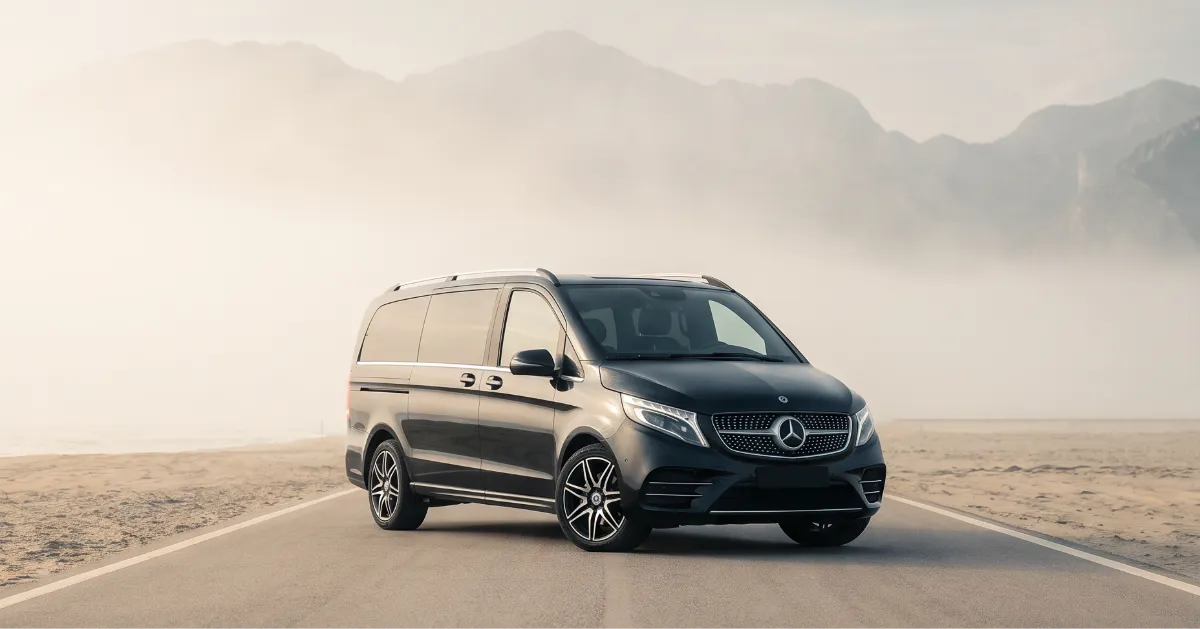
Two signals come from no answer at all. Fleet consistency is one: identical vehicles mean the same luggage space and no delegate boarding the visibly worse car. Tradycom runs an all Mercedes-Benz fleet — V-Class and Sprinter on group flows, E-Class for guests on separate schedules — so vehicles stay interchangeable on the day. Peak-week capacity is the other: in the Florentine trade-fair weeks, the wedding season and high summer between La Spezia and Forte dei Marmi, qualified drivers run out before vehicles do, and whoever subcontracts everything bids for the same subcontractors as everyone else.
Local operator, international broker or marketplace
Each model answers a real problem; the trade-offs differ.
| Local chauffeur operator | International broker | Marketplace / ride-hailing | Coach company | |
| Who drives | Its own drivers, plus declared colleagues | A local supplier it selects, often unnamed | Whoever accepts the job | Its own drivers |
| Accountability on the day | Direct, running the event itself | Via an account manager, usually off site | None beyond the app | Direct, within a fixed itinerary |
| Rural venues, restricted zones | Core competence | Depends on its local supplier | Not managed | Limited by vehicle size |
| Reserve capacity | Can be positioned on site | Contractual, executed by a third party | None | Slow, depends on free fleet |
| Best suited to | One country, complex access | Roadshows, consolidated procurement | Individual off-programme movements | Fixed routes, high volume, wide roads |
A broker sells procurement simplicity, and pays with a layer between you and whoever drives: local execution, reserve vehicle and venue knowledge belong to a subcontractor you did not choose. A local operator sells direct accountability, and costs you a second relationship if the programme also touches Madrid. For multi-city Italian itineraries the calculation shifts again, as in incentive travel transport logistics in Italy.
Reading an Italian quotation
Italian proposals are structured differently from US and UK ones.
- Engagement time, not driving hours. Pricing follows the time vehicle and driver are committed to you: a car waiting three hours outside a villa is engaged. Expect half-day and full-day disposizione blocks rather than an hourly rate with a minimum.
- Repositioning is priced. Empty legs to the pickup and back to base are real time and fuel, and a poorly sequenced plan generates many of them.
- Waiting allowance. Ask for the included minutes and the rule that starts the charge: the largest source of final-invoice disputes, and on group arrivals a subject of its own, covered in Pisa airport transfers for corporate groups.
- Coordinator and reserve vehicle. Each is included, charged per day, or absent. Absent is legitimate; not knowing which you bought is not.
- Extras. Permits, tolls, parking, venue waiting and out-of-hours bands are listed separately.
- VAT, deposits, payment. VAT appears as its own line rather than inside the headline figure, and the treatment for a non-Italian buyer depends on where your entity is established [TO VERIFY: Italian VAT treatment for non-Italian corporate clients]. A deposit is routine on peak dates, bank transfer is standard, card payment at volume is not always offered, and gratuities are neither automatic nor expected at US levels.
Two habits make quotations comparable. Send every supplier the same flow table — origin, destination, time window, passenger numbers — and ask them to price those assumptions. Then compare exclusions rather than totals: the lowest figure usually assumed least, meaning no reserve, minimal waiting, no coordinator and rotations that hold only if no flight is late. If the offer is a lump sum, ask the supplier to finish the sentence “this price no longer applies if…”. The same question covers late volume changes, which matter most on hybrid events, where the on-site delegate count settles very late.
Who answers during the event, and in what language
For a planner in another time zone this is the most practical question in the process, and the one least often asked. Establish four things in writing: who your contact is during the event, by name, and whether they were involved in planning; what hours they are reachable, and what happens while your team is asleep; what language they work in and, separately, what languages the drivers speak, since a multilingual coordinator does not help a delegate standing beside a driver at an airport exit; and who may tell a driver to wait — the answer should be the coordinator alone, because the moment a delegate negotiates with a driver the schedule stops existing. Continuity beats an emergency number: at Tradycom the coordinator is assigned in planning and stays to the final departure.
Frequently asked questions
What does NCC mean on an Italian transport quotation?
NCC stands for noleggio con conducente: a licensed private-hire operator, a regulated category of pre-booked chauffeur service, distinct from taxis and coach companies. It does not mean self-drive rental. Vehicles run up to around sixteen seats, with a named driver and an agreed schedule, which is why larger Italian programmes are quoted as convoys rather than coaches. In English the supplier usually calls itself a chauffeur service.
Should we book through an international broker or directly with an Italian operator?
It depends on how many countries the programme touches. A broker gives you one contract, one invoice and one account manager, which is valuable for multi-country roadshows. The trade-off is a layer between you and whoever drives: local execution, the reserve vehicle and the venue knowledge belong to a subcontractor you did not choose. For one country with real access complexity, contracting the operator directly usually buys more than the layer saves.
How can we check that a supplier owns its vehicles and employs its drivers?
Ask for proportions and names rather than reassurance. Which vehicles in this plan are yours, and which come from colleagues? How many of the drivers assigned to my programme work with you regularly? Who is the coordinator, named now rather than later? An established operator answers with figures and names; an intermediary talks about a partner network and defers detail until after you confirm the booking.
What is usually excluded from an Italian chauffeur quotation?
Most often: waiting beyond the included allowance, repositioning for movements added after the contract, overtime past the agreed window, permits, tolls and parking, and the reserve vehicle when it is on call rather than positioned. VAT is shown separately and a deposit is normal on peak dates. No exclusion is a warning sign in itself; one you find on the final invoice is.
Where to start
Put the three quotations side by side and ignore the totals. Compare exclusions first, then the reserve, then whether a coordinator is named. If two of the three cannot answer on those points, you do not have three suppliers — you have one supplier and two price lists. Then spend ten minutes with whoever will run the event on the ground, not the one who wrote the proposal.
Tradycom operates from Cascina, minutes from Pisa airport, and works regularly with agencies and DMCs planning from abroad. To have your transport brief reviewed, or priced against your real time windows, write to info@tradycom.com or call +39 050.8667849.