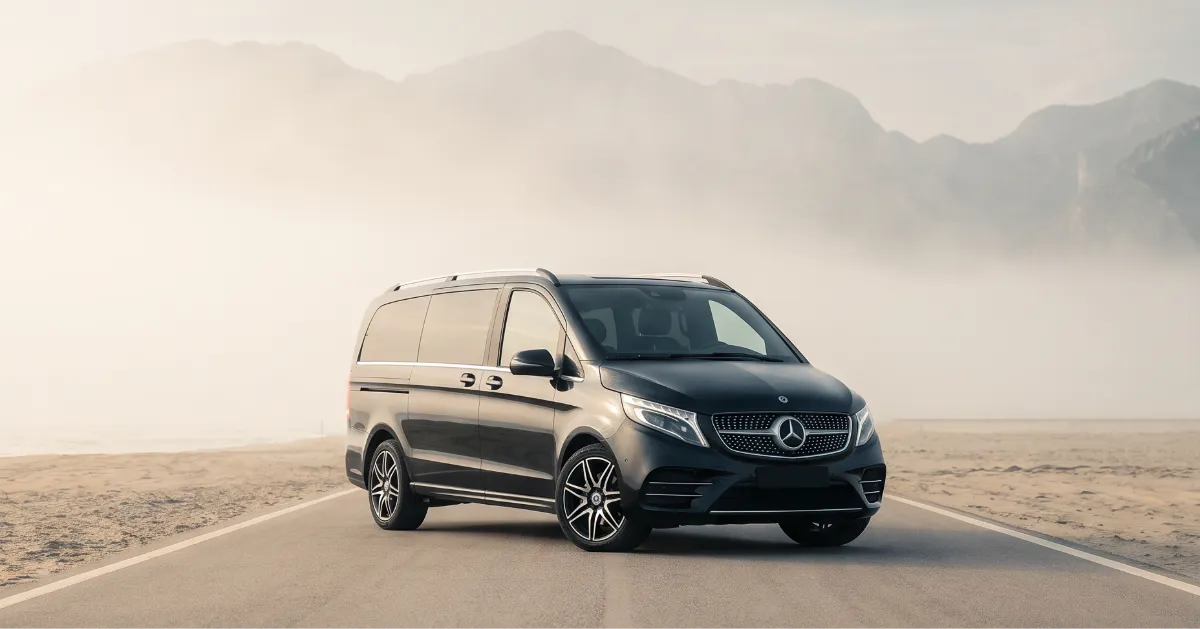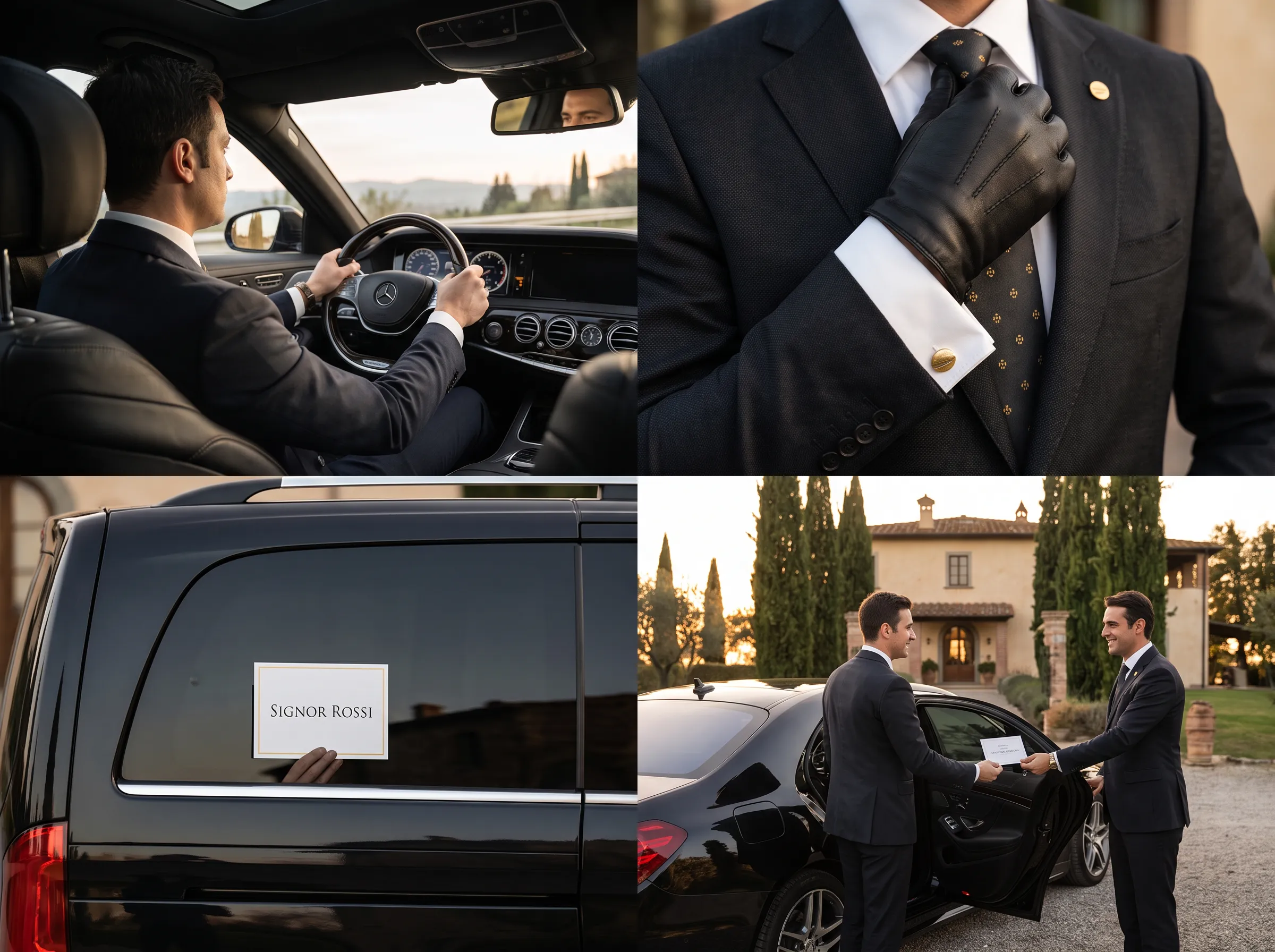
Most of the risk in a Tuscan incentive or corporate programme sits not in the venue, the catering or the content, but on the road between them. Corporate event transportation in Tuscany is the one component you cannot test in advance from London, New York or Stockholm, the one that depends entirely on local knowledge, and the one that quietly sets the tone of the programme.
This guide is for planners running their first event in the region: agency event managers, incentive houses, and DMCs briefing an Italian supplier they have never met. It covers what to ask and what to verify — a regulated private transport category that is not a taxi service, restricted-access zones in every historic centre, rural venues large vehicles cannot reach, and arrivals scattered across four airports. No prices here; what follows is a working method.
Why remote-planned events break on the ground
A transfer is the only part of a programme a delegate experiences awake, alert and with nothing else to do. It is also the only part of the run of show that cannot be compressed: a twenty-minute keynote can be cut to twelve, but an hour on the road is an hour. When a transfer leaves twenty minutes late, those minutes move forward through the day and land on the part of the evening you most wanted to protect.
Planning remotely adds a second failure mode: you work from assumptions you cannot verify. Drive times from a mapping app ignore coach-unsuitable roads; a venue’s “we have parking” may mean two cars. Almost every ground logistics failure here traces back to a detail that was assumed rather than confirmed.
First, the category: what an NCC actually is
In Italy, private transport with a driver is a regulated category of its own: a private chauffeur service — an NCC, or noleggio con conducente, a licensed private-hire operator. It is neither a taxi service nor a coach company, and the differences matter to a planner:
- Booking model. Pre-arranged assignments, not street hailing: vehicle, driver and schedule are allocated to your programme.
- Vehicle scale. Typically up to sixteen seats. Larger groups move as coordinated convoys, not in a single coach.
- Access. Smaller vehicles reach rural venues, narrow village streets and restricted city zones coaches cannot.
- Service level. Drivers are assigned, briefed and usually multilingual — closer to a hospitality role than a driving one.
For corporate programmes the usual answer is a multi-vehicle chauffeur plan rather than a coach contract: more per seat, fewer of the access problems that wreck schedules here. What a premium operator includes is set out in our guide to chauffeur services for corporate events in Tuscany.
Briefing a supplier you have never met
The most useful thing you can send a prospective supplier is not a delegate list. It is a flow table: every movement as a row, with origin, destination, time window, passenger numbers, and how certain that figure is.
Four flows exist in almost every programme, each governed by a different constraint. Arrivals are governed by uncertainty — scattered flights, delays, early birds. Daily hotel-to-venue shuttles by frequency, so rotation matters more than seat count. Off-site evenings by a single capacity peak. Departures by a hard deadline, and they are the least forgiving movement of all.
Send that table and you get an operational plan; send a headcount and you get a price list. It is also the fastest way to tell suppliers apart: the ones who come back asking about loading points and turnaround times have done this before. Our guide on choosing a chauffeur partner as an event agency covers the full selection process.
The gap between what a venue promises and what it can handle
Italian venues sell the experience, honestly. What they are vague about is vehicle logistics, because it is not their job and they are rarely asked precisely. Four questions close most of the gap, and they belong in writing:
- What is the largest vehicle that can physically reach the entrance? Not the largest allowed — the largest that can turn around.
- How many vehicles fit in the arrival area at once, and where do the others wait? A single-file courtyard changes the whole departure plan.
- Is the final approach paved? Many country estates are reached by unpaved strade bianche, slow in any weather and slower in rain.
- How far is the walk from drop-off to door, and is it lit and level? In evening dress, forty metres of gravel is a real number.
Where a venue cannot answer, a local supplier usually can, having been there. That is the concrete advantage of a regional operator such as Tradycom over a national broker.
Arrivals across four airports
International groups rarely land in one place. Tuscany is served by Pisa Galileo Galilei (PSA), the closest airport to most of the region, and Florence Amerigo Vespucci (FLR), roughly an hour east by road. Long-haul itineraries often route through Rome Fiumicino (FCO) or Milan Malpensa (MXP), both several hours away, with rail a viable alternative on some pairings.
Three rules keep multi-airport arrivals from consuming the budget:
- Group by waiting window, not by goodwill. Set a maximum wait per airport, consolidate arrivals inside it, assign dedicated vehicles to the rest — and tell delegates at invitation stage, not on the day.
- Decide long-haul routing early. Road or rail from Rome or Milan changes cost, timing and comfort, and is hard to change once flights are ticketed.
- Insist on flight tracking. Pickup times should move with the flight, without you sending a message from another time zone at 03:00.
Programmes with a faculty or speaker list — medical congresses in particular — need a parallel plan, since speakers almost never travel on the group itinerary. That scenario is covered in transport logistics for medical congresses in Tuscany.
Sizing the fleet
Usable capacity is not seats. It is seats multiplied by the rotations a vehicle completes inside the window, minus loading and unloading, minus buffer. Loading sixteen people with hold luggage takes far longer than seating seven with cabin bags, and on short transfers that can equal the driving time. Buffer belongs on the first movement of the day: delay only travels forwards.
| Delegates | Indicative mix | Sizing logic |
| 10–20 | 2–3 lounge minivans (V-Class, up to 7 pax), or one 16-seater plus an executive sedan | Single trip, no rotation. The sedan covers a senior guest on a separate schedule. |
| 20–50 | 1–2 sixteen-seaters (Sprinter) plus 2–3 minivans and a sedan | Flows separate: the main group travels together, minivans absorb off-schedule arrivals. Rotation works only on legs under about 25 minutes. |
| 50–100 | Convoys of 3–6 sixteen-seaters, support minivans, 1–2 sedans | Departures staggered in 10–15 minute waves. A spare vehicle on site and a dedicated coordinator become necessary. |
| 100+ | Multiple waves; larger vehicles on fixed legs, minivans for exceptions | The plan becomes a timetable, not a list: multiple assembly points, 10–15% structural capacity margin. |
The mix matters as much as the total: forty delegates in three identical vehicles travel like a school group; split between two group vehicles and two minivans for the leadership team, they travel like a corporate programme.
ZTL and historic centre access, explained from zero
Nearly every Italian historic centre — Florence, Siena, Lucca, Pisa and most hill towns — is protected by a zona a traffico limitato, a restricted traffic zone with camera-enforced gates. Rules, boundaries and hours differ from city to city, and unauthorised entry produces fines that arrive by post months later, often to the agency that made the booking.
Three things follow. A licensed local operator normally holds the permissions or knows the authorised loading points, so access becomes part of the service. “Can you get in?” is the wrong question; ask where passengers are set down and how far they then walk. And a hotel address inside a ZTL does not guarantee door-to-door access — expect a designated stop nearby and a short walk with luggage, which belongs in the timings and in the delegate briefing.
Contracts, invoicing and cross-border payment
A transport contract is irrelevant when the event runs smoothly. It exists for the two hours when something goes wrong. Six clauses to confirm before signing:
- Punctuality standard. How early the vehicle is in position, maximum airport waiting time, response time from your named contact during the event.
- Replacement vehicle. Maximum substitution time after a breakdown, the class of the replacement, who bears the cost.
- Cancellation and amendment. Separate terms for cancellation, volume reduction and time changes: three different events, not one penalty scale.
- Overtime. How time beyond the agreed window is calculated, and who authorises it on site. The most common source of invoice disputes.
- Insurance. Passenger cover and limits, confirmed on the certificate rather than verbally.
- Confidentiality. An NDA extended to drivers, not only the company, whenever the programme involves results, launches or public figures.
Commercially, clarify four points early: invoicing currency and who carries exchange risk; Italian VAT treatment for your entity, which depends on where the buyer is established [TO VERIFY: VAT treatment for non-Italian corporate clients]; payment method, since transfers are routine but card payment at volume is not always offered; and the deposit schedule, usually required well ahead on peak dates.
On-site coordination and the chain of command
Above roughly fifty delegates, or whenever more than four vehicles run simultaneously, the plan needs someone running it on the ground. This is a decision-maker, not an extra driver. Keep the chain of command one-directional: your team speaks to the coordinator, the coordinator speaks to the drivers. Delegates should never instruct drivers directly — the moment a participant asks a driver to “wait five minutes”, the schedule stops existing.
Four decisions should be assigned by name before the event: who may hold a departure; who may authorise a vehicle outside contract; who handles a delegate who misses a transfer; who communicates schedule changes. Planning from abroad, continuity beats an emergency number — at Tradycom the coordinator is assigned during planning and stays with the programme through the final departure, which also removes the language barrier between your team and the drivers.
Timeline checklist
T-60 days. Complete flow table. Written confirmation of venue access constraints. Preliminary fleet estimate and an availability hold — peak Tuscan dates sell out weeks ahead, so holding the fleet precedes signing.
T-30 days. Contract signed, with the six clauses above and the commercial terms. Transport plan converted from a list into a timetable. Coordinator named and chain of command circulated.
T-7 days. Consolidated flight manifest with delegate-to-vehicle-to-time matching. Driver briefing: names, languages, meeting points, signage, conduct. A written plan B for the two likeliest disruptions — a delayed group flight and bad weather on the off-site evening.
T-1 day. Every pickup reconfirmed with the owner of that flow. Physical check of loading points at hotel and venue at the hour they will actually be used. One spare vehicle positioned on site, not on call.
Frequently asked questions
Is a chauffeur service the right choice, or should we book coaches?
For corporate programmes in Tuscany a multi-vehicle chauffeur plan is usually the better fit. Coaches are efficient on fixed routes with large volumes, but many Tuscan venues sit on narrow or unpaved roads and historic centres restrict large vehicles. A licensed chauffeur operator runs vehicles of up to around sixteen seats in coordinated convoys, reaching venues coaches cannot and letting flows split by schedule. The trade-off is cost per seat; the gain is a plan that survives the real road network.
How do we handle delegates arriving at different airports?
Set a maximum waiting window per airport, consolidate the arrivals inside it, and assign dedicated vehicles to the rest. Communicate the grouping rule at invitation stage. Decide early whether Rome or Milan arrivals transfer by road or rail: the choice affects cost and timing and is hard to reverse once flights are booked. Insist your supplier tracks flights and adjusts pickup times automatically, so you are not managing changes from another time zone.
What is a ZTL and will it affect our programme?
A ZTL is a restricted traffic zone covering the historic centre of most Italian cities, enforced by cameras during set hours. Rules and boundaries vary by city, and unauthorised entry generates fines that arrive months later, often to the booking agency. It is manageable when a licensed local operator handles authorisations and knows the permitted set-down points. The practical impact is walking distance: a hotel inside a ZTL usually means a stop nearby and a short walk with luggage.
Can we contract and pay from outside Italy?
Yes — working with international corporate clients is routine for established operators. Confirm four points in advance: invoicing currency and who carries exchange risk; VAT treatment for your entity, which depends on where the buyer is established; payment method, since bank transfer is standard and card payment at volume is not always available; and the deposit schedule, usually required well ahead on peak dates.
When should we book transport for a Tuscan event?
Earlier than feels necessary. Spring and autumn concentrate demand across trade fairs, the wedding season and the harvest, and in those windows qualified drivers and suitable vehicles are committed weeks ahead. Availability, not price, becomes the binding constraint. Secure an availability hold once dates and venues are fixed, then finalise the contract as numbers firm up. Waiting for a final headcount is the most common way planners lose the fleet they needed.
Where to start
Work in this order: build the flow table, confirm venue access constraints in writing, size the fleet, and only then request proposals. A quotation requested before those three steps cannot be compared against any other, because each supplier fills the gaps with different assumptions.
When you go to market, send the flow table rather than the delegate list, and ask to speak with whoever will coordinate on the ground. Sequencing well also removes empty repositioning legs — the one change that cuts cost and emissions together, as covered in our note on sustainable corporate mobility.
Tradycom operates from Cascina, minutes from Pisa airport, and works with agencies and DMCs planning from abroad. For a review of the ground logistics on your next Tuscan programme, write to info@tradycom.com or call +39 050.8667849.