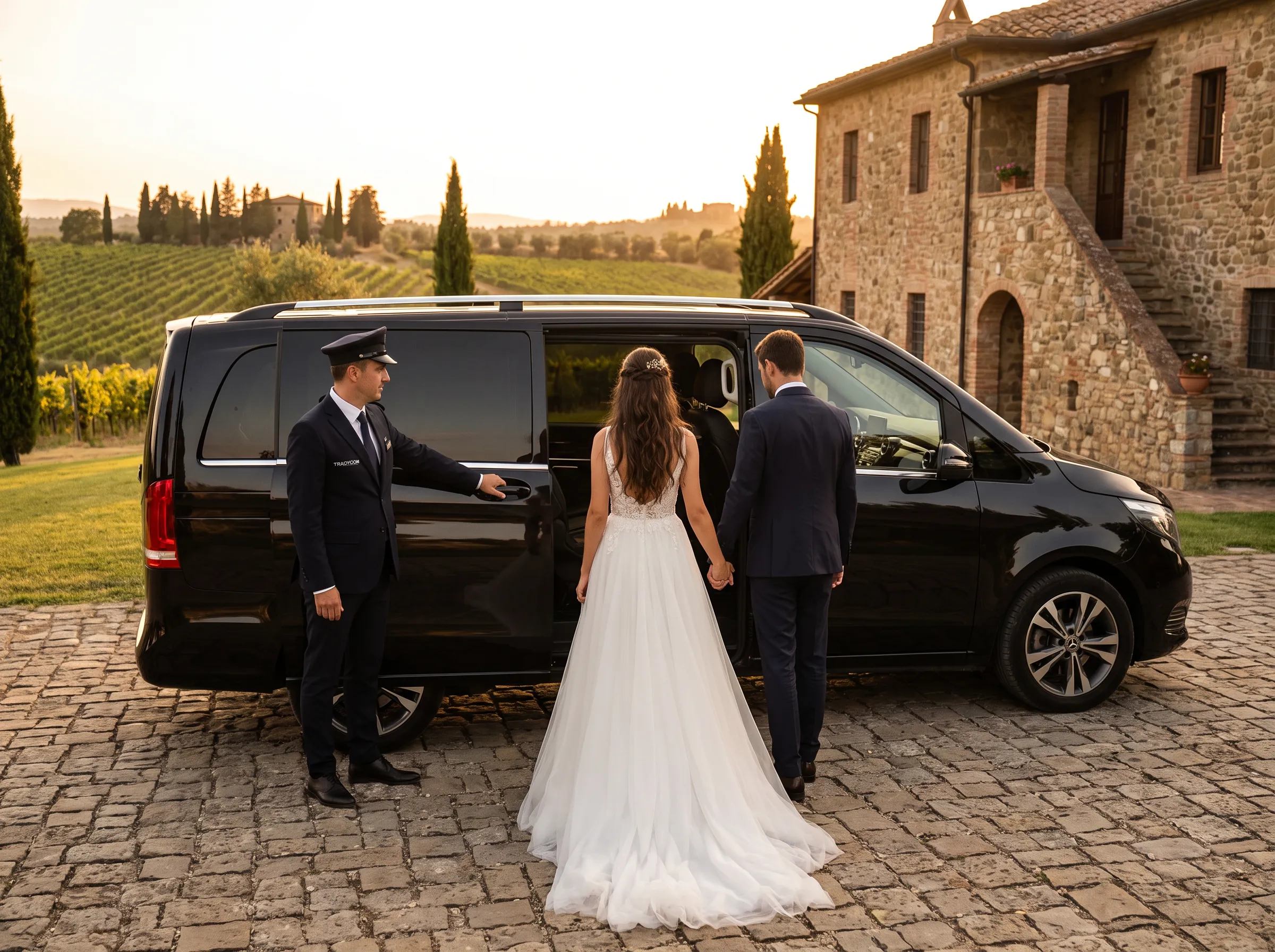
Most of the hard decisions in a Tuscan wedding are made by people who have never driven the roads involved. The venue is chosen from photographs, the hotels are booked by guests in four countries, and the planner often sees the access road two days before the ceremony. Wedding transportation in Tuscany is where that distance shows: a plan that looks tidy in a spreadsheet fails on a gravel lane too narrow for the vehicle you hired, or on a twelve-kilometre transfer that takes forty minutes. This guide is for planners working remotely and couples who want to understand what they are buying: how Tuscan geography behaves, how to size vehicles, who tells the guests what, and what to settle before paying a deposit from abroad.
Why Tuscany is harder to plan than the map suggests
Tuscan wedding venues are almost always outside towns: restored farmhouses, private villas, castles, estates at the end of a cypress drive. They were chosen because they are remote, and remoteness is the logistical problem. Public transport, where it exists, runs on commuter timetables and stops kilometres from the gate, and taxis cannot be summoned in the countryside in any number. That leaves guests driving themselves — a poor idea when there is an open bar — or an organised plan.
Distances in Tuscany are measured in minutes
This is the most useful correction for a planner working from another continent. Fifteen kilometres on a map can mean forty minutes on the ground: a ridge road with no centre line, a tractor, a stretch of strada bianca (unpaved gravel road) where a long vehicle can only crawl, and a final kilometre where two vehicles cannot pass.
Three anchors help. Pisa is the closest major airport to much of the wedding country, on the coastal side of the region. Florence is roughly an hour east of Pisa in normal conditions and is the gateway to Chianti. The Val d’Orcia, south of Siena, is considerably further from both, and transfers there are measured in hours. Never build a timeline on a mapping app alone: ask your supplier for the real drive time, in the same season and at the same hour.
What the vehicle can physically reach
Three constraints decide which vehicle reaches which venue. Road surface: gravel means slow, and in July it means dust on a dark car and a pale dress. Turning circle: many villas have one access drive and no turning area at the end, so a minivan manages, a sixteen-seater sometimes does not, and a coach almost never does. Restricted traffic zones: Florence, Siena, Lucca, Pisa and most historic towns operate limited-access areas with their own hours, which a licensed operator can work within and a hire car cannot.
What you are actually booking
In Italy, private transport with a driver is provided by an NCC, or noleggio con conducente — a licensed private-hire operator. Throughout this guide we call it a chauffeur service. It is not the same product as a North American limo service.
The practical differences matter when you are comparing quotes:
- Journeys are booked, not hailed. The service works from a written schedule agreed in advance, with no meter and no roadside pick-up.
- The vehicles are different. The Italian wedding fleet is executive saloons, lounge minivans and Sprinter-type minibuses, not stretch limousines.
- The driver is part of the service. Chauffeurs are trained in hospitality, manage timings and stay with the vehicle.
- Licensing is checkable. A legitimate operator holds an NCC licence and commercial insurance, and will document both on request. Tradycom, for example, has operated as a licensed Italian chauffeur company since 1970 and is now run by the third generation of the family.
For more depth, including how to brief an operator on a multi-site wedding, see our companion guide to private transport for an Italian wedding in Tuscany.
The five flows to plan separately
Treating transport as one line item is the most common planning error. There are five flows, each with its own vehicles, window and point of contact.
- Arrivals in Italy, spread across several days and several airports; handling international arrivals for an Italian wedding is a plan of its own.
- Pre-wedding movements: welcome dinner, rehearsal, group excursions and, where the party organises them locally, dedicated transport for a bachelor or bachelorette party in Tuscany.
- The wedding day, dense and with no tolerance on the ceremony time.
- Late-night returns, the flow most often underestimated.
- Departures, spread over two or three mornings and planned with the hotels.
Combine them into one order and the first delay takes all five down.
Sizing the fleet: guests, journey time, rotations
Fleet size comes from three numbers: how many people, how long one leg takes, and how wide the window is. From those come the rotations, and only then the vehicles.
The formula is one rotation = drive time × 2 + loading and unloading + margin. On a twenty-minute leg a full rotation rarely costs less than an hour, so a ninety-minute window buys one and a half rotations per vehicle, not two.
| Guests to move | Typical vehicle mix | Rotations | Operating logic |
| Up to 20 | 2–3 minivans (7–8 seats) | 1 | Reach anywhere, including gravel and narrow drives. |
| 20–40 | 1 minibus + 1–2 minivans | 1–2 | The minibus carries the bulk, minivans cover off-schedule guests. |
| 40–80 | 2 minibuses + 2 minivans | 2 | Stagger rotations by 20–30 minutes rather than sending them together. |
| 80–130 | 3–4 minibuses + 2–3 minivans | 2 | A coach would cost less but often cannot reach the venue. |
| Over 130 | Coach on the long leg + shuttles for the last stretch | 1 + relay | Transfer point below the venue, with staff dedicated to the handover. |
Two rules override the table. Stated capacity is not usable capacity: eight adults in formal wear are not the eight seats on the specification sheet, so plan around 85 per cent occupancy. And if access is in doubt, two medium vehicles beat one large one — the second vehicle’s cost is known in advance, while a coach stopped at a narrow gate is paid for in lost time.
The wedding day, hour by hour
- Morning. Suppliers and family move between properties. If the couple prepare in different places, one vehicle should be dedicated to that.
- Mid-morning. Guests move from hotels to the ceremony. Plan backwards: real drive time, plus boarding, plus a margin for late guests. Guests should be seated fifteen minutes before the bride arrives, not five.
- The couple’s arrival, in separate vehicles with separate departures if they are not travelling together. Whether that car is a vintage or a modern one depends on the access road and on the dress, not only on the photographs.
- Ceremony to reception. The tightest window of the day: everyone leaves at once, within a period the caterer has already budgeted.
- Afternoon. Photography locations, early returns for guests with children.
- Evening and night. Staggered returns across several windows.
Late-night returns, where most plans break
Morning transfers work because everyone shares a deadline. Night returns have none. The classic plan has two shuttles, one at midnight and one at the end of the party. Almost nobody leaves at midnight; at half past one, forty guests want to go at once and the vehicle seats sixteen.
Four principles make the plan hold. Run four or five departure windows in the second half of the evening, not two. Size for the peak window, not the average. Communicate the times redundantly: on the programme, on a sign at the door, and announced once aloud. And give each vehicle one destination, since mixing hotels on a late-night run produces long loops and guests set down at the wrong door.
One constraint sits outside the planner’s control: drivers are subject to driving and rest rules, so a service running from seven in the morning to three the next morning is not one shift but a plan with driver changes built in.
Guest communication: who tells whom, and when
Transport plans usually fail at the communication layer, not the operational one. Decide early who owns each message.
- The wedding website carries the standing information: which airports to use, whether transfers are provided, and the deadline for flight details.
- One form collects flight data — flight number, arrival time, airport, bags, mobility needs, child seats. Not email, which is the main cause of arrival errors.
- A personal message reaches each guest 48 hours before, with pickup point, time and a name to contact on the ground.
- The venue carries the evening schedule, because guests forget what they read three weeks earlier.
Time zones make this slower than it looks: if half the guest list is in the United States or Australia, every clarification has a twelve to twenty-four hour response cycle. Set internal deadlines a week earlier than feels necessary.
Contracts, deposits and paying from abroad
Expect a different commercial shape from the one you are used to at home.
Italian suppliers usually quote from a programme, not a per-hour rate card. Cost is driven by vehicle engagement time — a vehicle held at your disposal is charged even when parked — plus repositioning, how many vehicles run simultaneously versus in rotation, night and high-season hours, and extra staff such as a ground coordinator.
Practical points for an international booking:
- A deposit confirms the booking, with the balance settled around the event. Agree the schedule in writing.
- Bank transfer in euros is standard; ask about card payment early, not at the final invoice.
- Confirm whether quoted figures include VAT.
- Fix in the contract the guest-number threshold at which a vehicle is added, and the last date to change it without penalty.
- Ask about cancellation terms and what happens if the ceremony time shifts.
Drivers, language and the Tuscan season
Two questions decide the quality of the day more than the vehicle specification does.
Do the drivers speak English, all of them or only some? With four vehicles running, every driver needs to answer a guest’s question, not just the lead one. Ask for a direct answer, not a reassurance.
Is the date inside the high season? Tuscan weddings concentrate between late spring and early autumn, and qualified drivers — not vehicles — are the scarce resource on a Saturday in that window. Reserve your operator as soon as date and venue are fixed, even with a provisional programme, and refine the detail later.
Ask also whether the operator has worked at your venue, and if not, whether they will drive the access road with a vehicle of the size you intend to use. That site visit prevents most of the failures described here.
The remote planner’s timeline
Three months out
- [ ] Three-day programme with indicative times
- [ ] Hotel list with estimated guests per property
- [ ] Written confirmation from the venue: largest vehicle that can reach it, where it waits and turns
- [ ] Operator reserved on the programme, not on a guest count
One month out
- [ ] Guest numbers confirmed and assigned to each flow
- [ ] Flight data collected on a single form
- [ ] Shuttle plan written: pickup points, times, capacities, rotations
- [ ] Child seats and mobility needs passed to the operator
One week out
- [ ] Final schedule shared with operator, venue and caterer
- [ ] Named passenger list per vehicle and stop
- [ ] Guest messages sent with pickup times and a contact name
- [ ] Wet-weather alternative for outdoor pickup points
The day before and the day itself
- [ ] Every inbound flight reconfirmed
- [ ] One transport contact reachable until the last departure
- [ ] Headcount at each departure, and evening times revised if the party overruns
Frequently asked questions
How far in advance should we book wedding transportation in Tuscany?
The binding constraint is the availability of qualified drivers on high-season Saturdays, not the time it takes to plan. Reserve the operator as soon as date and venue are confirmed, even with a provisional programme, and refine details later. A quote can be revised; a committed Saturday between May and September cannot. Think in months of lead time rather than weeks.
How many shuttles do we need for 100 guests?
It depends less on the headcount than on the drive time and the width of the window. With a twenty-minute leg and a ninety-minute window, a sixteen-seat minibus completes roughly one and a half rotations, so 100 guests need three or four vehicles of that size plus one or two minivans for those travelling outside the main block. If the leg is forty-five minutes, more vehicles must run at once, because a second rotation does not fit.
Can a full-size coach reach a countryside villa?
Often not, and this must be checked before booking one. The limits are the width of the access road, the turning circle at the end of the drive and the road surface: many Tuscan villas have a single approach with no way to reverse out. Where a coach cannot reach the venue, the standard solution is a transfer point lower down with smaller shuttles running a relay, planned in advance.
Is an Italian chauffeur service the same as a limo service?
No. An Italian chauffeur service, licensed as an NCC, works from a booked schedule rather than on demand, and its wedding fleet is executive saloons, lounge minivans and minibuses rather than stretch limousines. The driver is trained in hospitality and stays with the vehicle for the agreed period. For a wedding this is the better product: the day is a sequence of timed movements, not one hire.
Who pays for guest transport at a destination wedding?
There is no fixed rule, but a common convention: the couple cover group transfers tied to the events — hotel to ceremony, ceremony to reception, and the returns — while guests arrange their own arrivals and departures. Many destination couples also include airport transfers, which remove the main source of friction for travelling guests. Publish the decision early, because it affects how guests book flights.
Where to start
If you are planning from abroad, start with two documents rather than a quote request. The first is the three-day programme with indicative times, including the last departure of the night. The second is written confirmation from the venue about vehicle access: the largest vehicle that can reach the door, and where it waits and turns. Almost every transport problem at a Tuscan wedding traces back to one of those being assumed rather than confirmed.
Tradycom is based at Cascina, two minutes from Pisa airport, with a recent Mercedes fleet and multilingual drivers. If you have dates and venues and want the plan tested against real drive times and access constraints, write to info@tradycom.com.